Saturday, June 16, 2018

Letting it go

One of the reasons I was asked to go on my recent missions trip to Jordan was because of my familiarity with the culture and the fact that I know some Arabic.

Let me qualify that last statement.  In 1999, I graduated from Durham University with a degree in Arabic with Middle Eastern and Islamic Studies.  I spent my second year of that course in Damascus, Syria.  Since then, I have barely used Arabic.  I have rarely needed to speak it, so--although my ADD doodling during meetings at work usually takes on the form of Arabic writing--to say I am rusty would be a huge understatement.

When my team heard that I could speak Arabic, they were very excited.   As much as I tried to warn them that my language skills were likely to be limited and certainly not what they were hoping for or expecting, my sense was that they were looking forward to having a bona fide translator in their ranks.  When I arrived, most of the team had already been there for a week; after less than 12 hours on Jordanian soil, I was pressed into action almost immediately and assigned to the photography class to help translate the instruction, in English, for our refugee students, who spoke Arabic.

It was an unmitigated disaster.

Never mind that I had just stepped off the plane.  Never mind that I knew nothing about photography in English, let alone Arabic.  Never mind that translating into your non-native language is much harder than the other way round.  I hadn't spoken Arabic - properly, when there was no other option - in nineteen years!
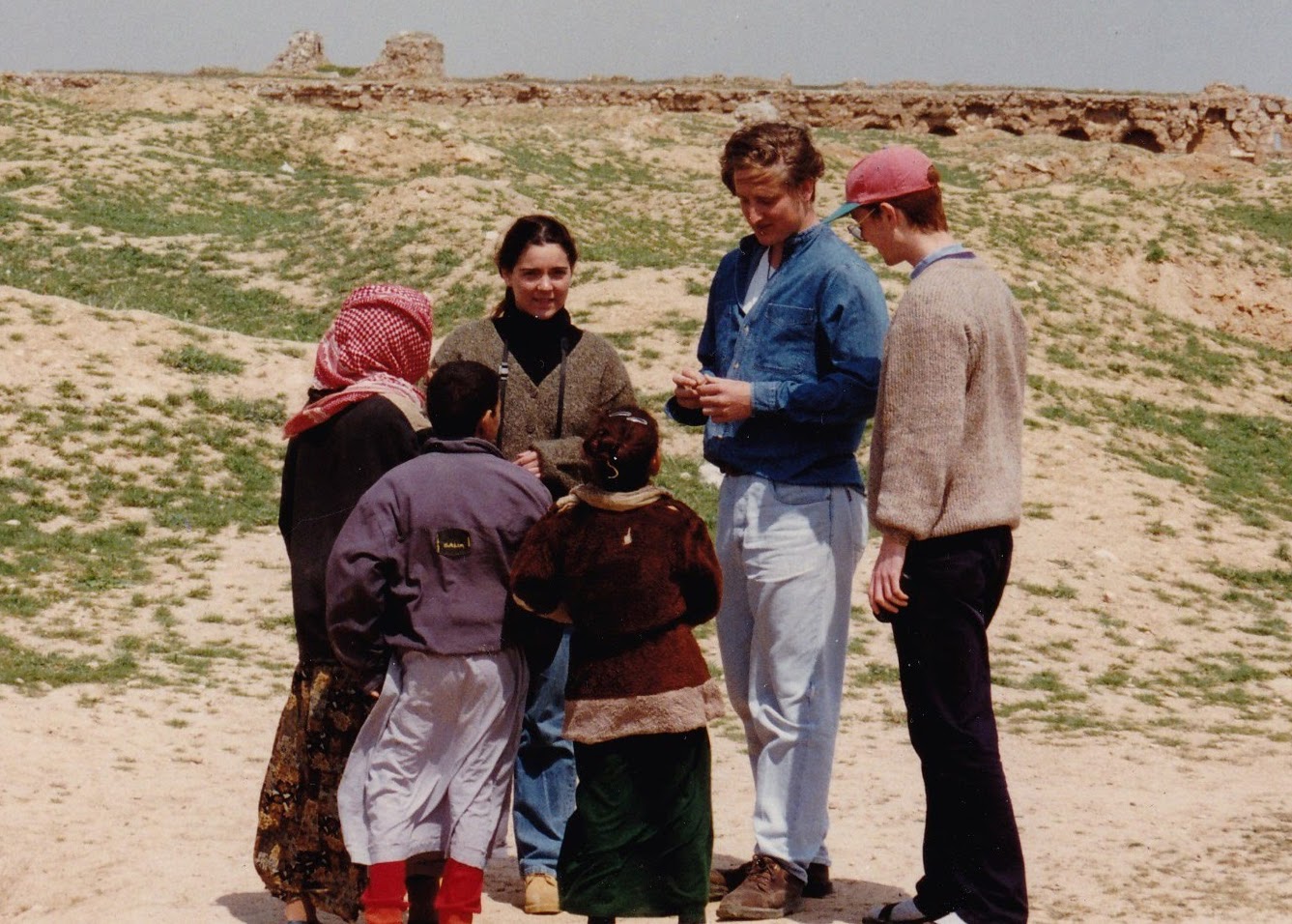
Syria, April 1997: What I looked like one of the last times I spoke Arabic properly.

I spent that evening and most of the next day wanting to go home.  I felt like I had let my team down.  I felt like they had had unreasonably high expectations, and I wanted to retort, with savage satisfaction, "See?  I told you!"

My teammates went out of their way to be understanding, placating, and reassuring, but I continued to feel under immense pressure to deliver in all situations--from negotiating donkey rides at Petra to helping translate menus--and with each failed attempt, my confidence and pride shrank while my frustration mounted.  I could remember random words and phrases, but always after the fact; when it was really needed, I found myself unable to recall simple words--verbs, especially!--thus, rendering my attempts impotent while my poor teammates just wanted to know what was going on.

I remember after our bus driver dropped us--the team and the photography class we were teaching--at Um Ajmal, the site of some Roman ruins, and to my intense frustration, I couldn't even figure out how to arrange a pick-up time with him.

While my annoyance and embarrassment ebbed the longer I was in Jordan--we were still able to function just fine as a team--it wasn't until one of my last home visits that I had a breakthrough.

At the end of the home visits, our translator would usually ask the refugee family if it was OK if we prayed for them.  Either our translator would pray (and then translate later after we'd left), or one of our team would pray in English and the translator would translate into Arabic for the family.  One of the things I had desperately wanted to do was to pray in Arabic.  I had asked the pastor of the church we were staying at for some phrases that I hoped I could--maybe--string together into something intelligible.  But such was my lack of confidence and my overall discouragement that I never piped up to volunteer a prayer.

On our second to last home visit, things were going as normal.  We were sitting on blankets and thin mattresses in the living room (which almost certainly also functioned as a bedroom at night), drinking hot, sweet tea, and talking to a family.  One of the women had just come back from the police station, asking for news of her husband, who, it turned out, had been arrested and returned to the refugee camp where the family was supposed to be, and she now faced the desperately difficult choice: to stay put and be separated, along with her children, from her husband, or to return to the hardship and despair in the refugee camp in order to keep her family together.  Despondency was etched into her face as she sat with her sister and mother-in-law.  Yet for all their tragedy and trauma, this family still managed to graciously host us and show genuine interest in us.  As the time to leave came to an end, Mike, our team leader, said, "Jonathan - this is your last chance to pray in Arabic."

For a moment I sat there, paralyzed with indecision: could I do this?  What if I messed up?  What if "heart" came out as "dog" (the words are very similar in Arabic)?  With sudden understanding, I realized that this family needed comfort, and not the kind of comfort that we could provide.  It wasn't going to be about me.

And so I prayed.

I have no idea whether what came out was correct or appropriate, and I can't even remember what I was trying to say or communicate other than an overwhelming desire for the family to know God's peace, but in that moment, I felt that I finally understood that I had to take the attitude of a servant when it came to my language and my proficiency in it.  When I finally let go of my ego and my desire to be "the man", it allowed me to be used.

I had gone to Jordan to serve, but when it came to my language skills, in my arrogance, even knowing how difficult it was going to be, I did not take that same approach.  I allowed my pride and shattered confidence to impact how I served.  In fact, I was trying--pretty hopelessly--to lead, not serve.  And, looking back, it seems like the times when the team and others around me benefited the most from my Arabic was when I struggled the most.

Struggling, as I tell my students on an almost daily basis, is important.  It teaches us valuable lessons.  However, struggling with a proud heart and a fragile ego is not likely to go well for us.  Only when we let those things go and give ourselves completely to the task at hand will we see the unlikely and unexpected fruits of our toil.


Thursday, April 19, 2018

Stained by the sand

I recently returned from a missions trip to Jordan, and it's been a difficult transition.

I have felt listless and disquieted as if I am waiting for something but I'm not sure what.  My experiences already feel very far removed and I worry that I will forget the lessons I've learned and people I've met; I fear that their stories, once sharp and focused, will disappear into a jumbled haze of vague recollections.  I miss my teammates, people I didn't really know two weeks ago and with whom I was pressed into a sort of forced intimacy and yet on whom I came to depend for so many things.

One of the most difficult aspects of returning to my "regular schedule" has been answering the question, "How was your trip?"  In fact, the very thought of being asked this question caused me so much anxiety that I had a mild panic attack before I started teaching on Thursday morning.  How could I walk into my classroom and face students, all of whom, in their own sweet ways, would be curious, polite, and maybe even genuinely interested in where I'd been?

On Friday, I was still feeling out of sorts.  It was a beautiful spring day, and I was summoned home early from work by my wife so that we could all go to the beach together.  When we arrived, I laced up my dusty Merrells and headed south along Highway 101 for a much-needed run, my first in at least two weeks.

I usually do a lot of thinking on my runs, but on this particular one, I don't remember thinking about much.  I was mainly enjoying looking at the gastropubs, coffee shops, and boutiques that I ran past.  Honestly, I was trying not to think about Jordan.  My legs felt good, and my lungs were working hard enough to be pleasantly sore but not make my breathing too ragged.  My shoes and socks felt a little weird, though, as did my feet.  I could feel grains of sand between my toes; clearly, I had forgotten to empty out my shoes from the last time I had walked in the sand...
Stained by this sand from Wadi Rum, Jordan.
6 days previously, I had been sitting, hungry, bleary-eyed and sleep-deprived, at the top of a rocky outcrop in the sand of Wadi Rum, a desert valley in southern Jordan.  It was just after 6 a.m., and we were watching the sun rise over the sheer pinnacles and dramatic cliffs of granite and sandstone.  We'd had a couple of days off from our work with refugees, and the long bus ride, late-night arrival, and some decidedly atypical poor hospitality at a decidedly dodgy campsite unfortunately named "Rum Magic" had left us - even with the spectacular sunrise - disgruntled and longing for the relative comfort of our lodgings back in Mafraq, a town 10 km from the Syrian border.  I hadn't even taken my shoes off that night, and 10 hours in the desert - of which only three were spent sleeping - ensured that a good amount of sand had made it both onto and into my socks.

I ended my run where I had started it, at Ponto Beach.  My kids were playing in the water and my wife was watching them.  In the late afternoon sun, the sea was glittering and the breeze was rapidly cooling my sweaty limbs.  I took off my shoes, peeled off my socks, looked down, and gasped.

My toes were a deep rusty orange.  As I stood on a beach in Southern California, it was the sand from Wadi Rum that I could feel and see, mixed with sweat and dust.  I showed my wife and kids, we had a good chuckle, and then I waded a few steps into the ocean to rinse my feet off.  As usual - when it's not August or September - the sea was numbingly cold and I didn't last long.  Walking back up the beach, I looked down once more.  The sand's stain was still there.  Jordan's influence wasn't going to wash away easily!

Even the most frustrating, mundane, and uncomfortable few hours of my time in Jordan has stayed with me.  How much more, then, will the sublime moments, the heart-breaking stories, and the feelings of true fulfillment remain engrained in my mind!

I had been worried that I would leave my memories of Jordan behind me when I came home, but as it turned out, Jordan came home with me.   And I don't think I'm going to be able to just wash it off.


Wednesday, July 19, 2017

Time to Reflect

I started this on June 21st, but didn't have it completed until after I returned from a 3-week road trip.

The school year is over.  Graduation happened last night.  The summer has officially begun.

It usually takes me a day or two to really get into holiday mode.  The end of the school year is particularly frantic and fraught with stress.  Graduation night is usually an emotionally draining experience: there are bittersweet farewells to former students and then there's the post-ceremony catharsis (and adult beverages) with colleagues.  So I am not used to relaxing yet; in my still active mind, the feeling of the need to be doing something - grading, lesson planning, obsessively checking email - has yet to dissipate.

In this strange time window, where I am physically but not yet mentally on vacation, it is time to reflect on the past 10 months in the classroom, and it hasn't taken me long to come to this conclusion:

I sucked.

Or, to put it in more British terms, I was pants.

["Pants", by the way, is being used as an adjective.  A predicate adjective in this case.]

I had realized this a few weeks ago when another batch of essays arrived on my desk full of the same errors, the same limp, vapid analysis, and the same lack of literary understanding as the last lot of essays.  Last night, many colleagues (reflective, genuine, and not untalented educators) were coming to the same conclusion.  Not that they also thought that I was pants (maybe they did), but they, too, also experienced an incredibly challenging year seemingly filled with more failures than successes.  I was not the only one who expressed that this had been the hardest year of my career.

My classroom management was poor, my students' work showed little signs of improvement, and I clearly did not connect with my students on the level to which I was accustomed.  Most of my students continued to willfully resist reading, and I did not inspire them.  And if I'm being completely honest, there were some students that I was glad to see the back of as they surged out of my classroom on that last day.  For many of them, I am sure the feeling was mutual.

As a team leader and department chair, I failed miserably in ensuring that our curriculum revamping would be complete by the summer: it wasn't.  Not even close.  Ever the introvert, I retreated to my classroom to grade papers instead of joining the team for lunch, thus neglecting the relationships I had built with my amazing department members.  I was not a good teacher, and I was not a good colleague.

So here, of course, is the horrible paradox of reflection: it is an inherently useful practice that often makes us feel useless.

Then I remembered what I, in a weary, final fit of passion on finals day, told my students yesterday.

You made it.  You are sitting here in this classroom and you didn't give up.  You could have, but you didn't.  Many of you had to deal with significant challenges to make it this far, and I have to tell you, I find that inspiring.  Maybe you didn't end up with the grade you'd hoped for, but the grade you got in this class is not in any way a reflection on your value as an individual. 

(It wasn't as eloquent as this, and it sounded rather trite and cliched when I said it, but you get the idea.)

Additionally, I recalled what, for the last year has been my mantra in the classroom: you can only succeed unless you fail.  Over and over again, I have assured my students that failure is a good thing and that learning to deal with it is an essential life skill.  The reflection that you do in the aftermath of defeat, in that lonely, hollow place amid the cold ashes of your expectations - that painful process of metacognition - is absolutely essential when it comes to growth and learning.

The irony here, as you will have noticed by now, is thick.  Wallowing in my own inadequacies, I was not doing the very things that I require of my students.  I, a grown man, was incapable of doing something I expect from a teenager.  And so, I wondered, what would I tell myself if I was one of my own students?

You made it.  You stood in front of the classroom and you didn't give up.  You could have, but you didn't.  You had to deal with significant challenges to make it this far, and I have to tell you, I find that inspiring.  Maybe you didn't end up with the results you'd hoped for, but the performance of your students this year is not in any way a reflection on your value as an individual. 

On reflection, then, what were my "significant challenges"?

Halfway through the year, I started implementing a new, standards-based grading system that focused on assessing students on what they can do, not what they can recall, and ended the system of punitive grading.  It was a massive, seismic personal philosophical shift, and I knew it was the right one, but I struggled mightily in its implementation.  I did my best to guide my team (in our first year as a 9-12 ELA department) through a textbook pilot and adoption process as well as starting the new curriculum writing process with the establishment of a broad and comprehensive vertical vision for our department.  It was very, very difficult to do, but it was essential.  I wasn't successful, but it's not complete yet, and I know we're moving in the right direction.

I'm used to pouring everything I have into my classes, but because these challenges consumed me I probably had less to pour as a result.  Small wonder, then, that I struggled like a first-year teacher with everything else in my classroom!

I will return in August, refreshed and ready.  I am ready to put right the mistakes I made, and, most importantly, I am prepared to persevere in doing the things I know are difficult but nonetheless pedagogically - and morally - sound.  It is amazing that after all my efforts at teaching my students about failure, it was my students who taught me my most important lesson yet: that failure is not a sign that you are on the wrong road; rather, it's a sign that you are on the right road, but you are going to have to work harder to stay on it.

Yes, this year was a challenge.  But the struggles will count for nothing if I don't embrace one final, difficult challenge: practicing what I preach.

So here's to reflection, pants and all!

Wednesday, April 26, 2017

When my slowest half marathon was my most memorable one


I'm a competitive person.

As a child, and the oldest of six, I used to keep notebooks of lists and records - birds I'd seen, goals I'd scored during break time hockey on the quad, relays around the house with my brothers, even F-Zero on the Super Nintendo.  Let's just say that It was a dark day when my youngest brother beat my course record for Deep Blue 2.  

As a father, I see the same streak in my oldest son.  He would be the kid who would keep the score in Single-A baseball and announce it loudly.  "We're winning 23-2!"  Talking about his day at school usually involves telling us how many games of soccer he won in P.E.  He competes - really competes - against his younger brother in everything, from water bottle flipping to driveway basketball.  The apple doesn't fall far from the tree.

Running has been a great way to channel my competitiveness.  I've no chance of winning any of the races I enter, so I am ultimately competing against myself.  It has driven me to train harder, and I credit it for the fact that I am faster now at 40 than I was at 33.

Nonetheless, even in running, I find ways to compete against others.  I will look up the results of people whom I know have run the same race as me or who recently ran a race.  I use their quicker times as motivation, and when I am in conversation with other runners, I do admit to a degree of smugness if my PR is faster than their PRs.  And, I must confess, I would love it if others looked up my times and found them impressive.

Now that I've outed myself as a narcissist, I hope the following will resonate more.

Months ago, I signed up for the Encinitas Half Marathon and the Carlsbad 5000.  These races would be run on consecutive weeks at the end of March and the start of April, and my lofty goal was to lower my PR considerably in both runs.  At the end of January, things were looking good; I'd run the Carlsbad Half Marathon in just over a minute outside my PR, so I thought I had a shot at achieving my goal.

Then I got injured.

I basically spent February off my feet, and I eventually accepted that these races would not see me PR.  After a few weeks, I stopped sulking and told my wife that I would just have to run the races for fun - for the sheer enjoyment of it.

"Don't you always run for fun?  Don't you always enjoy it?" she asked.

"It's complicated," was all I had in reply.

And it is complicated.  I don't enjoy getting up when it's still dark and cold to start my weekend with a long run.  If I truly ran for fun I wouldn't need a training schedule.  It is not particularly fun when your lungs are threatening to burst at mile 12 of a half marathon.  It is not particularly fun to hit the wall at mile 21 of a marathon when all you can feel is boredom and hunger (for you certainly can't feel your legs).  Certainly, I enjoy the feeling of accomplishment upon completing a race, after successfully running to a plan, and achieving a good time.  At times, that feeling has been close to euphoria.   But that comes at the end of the race.  During the race, it's mostly pain.  

I run, not necessarily to say that I've done it, but to know that I've done it.   And for the post-race beer.

It so happened that a former colleague and good friend of mine, Justin, whom I've run with in the past, was running the same half-marathon.  He's usually a 2:05-2:10 guy, so I thought I'd offer to run with him, seeing as I was unlikely to go much faster myself.  Then came his revelation: he'd had a less than ideal preparation for the race too, and he thought he'd be running at a 11-12 minute mile.  Two and a half hours for a half marathon?  It would be my slowest by far, but it was too late; I'd offered to run with him.  

I hadn't seen Justin since August, and when we met up before the start, it was clear we had a lot of catching up to do.  As we waited for the race to begin, I bumped into Dax, another friend.  He's an accomplished ultra runner, but I also admire him because he really does run for pleasure.   Chatting on a cool cloudy morning, the Pacific Ocean grey behind us, with runners of all shapes, sizes, and abilities limbering up around us, and feeling neither pressure nor nerves,  I was already enjoying myself.

The race started.  Dax headed off towards the front, and Justin and I merely continued our conversation as we moved forward with the rest of the pack.  We meandered north and then south on Highway 101.  My iPod headphones dangled out of my shirt, unused, as Justin talked about his recent trip to England.  I told him about my big shift in my understanding of assessment of my students.  He gave me tips on where to go in Costa Rica.  I unloaded some of my anxiety about being a department chair.  

We took in the sights of Swami's, actually stopped to drink at water stations, waved at friends and acquaintances along the course, and marveled at how inviting the water looked as we ran around the parking lot at  Seaside State Beach in Cardiff.  The conversation waned a little towards the end as fatigue set in, but I was content.   I had spent two and a half hours (2:29.15, to be precise) really connecting with a friend.   

I had just run a half marathon for fun.
We ran slowly, and we're not as young as we used to be...
 Among the medals from races hanging up in my bedroom, there is an unusual one.  Little more than a string with a few beads, it is nonetheless my favourite and most cherished running keepsake.  It is one of a kind, handmade by Dax's daughter, and I earned it after an informal trail half marathon one brutally warm summer's morning.  After 3500 feet of elevation gain, running out of water with two miles left, and encountering a particularly bad-tempered rattlesnake at the top of a lung and thigh-destroying climb, I ended the race physically spent.  My exhaustion (and faint annoyance with my friend for putting me through the ordeal) faded as the unique medal was placed around my neck and a cold beer thrust into my hand.  I sat, recovering, on a rock, looking out from one of the highest points in San Diego County, in the company of friends. That "race" took me over three and a half hours (I'm not actually sure because my Garmin died after 10 miles), but I ended it as fulfilled as I have ever been after a run.   


The medal I got at the end of the Encinitas half marathon looks a little more conventional, but I will look at it with a similar feeling of contentment and affection.  Running can be about competition, pushing yourself to the limit, and trying to run the perfect race, but it can also be about friendship, connecting, and fulfillment.  Conveniently, the post-race beer can be equally refreshing in both scenarios.

My slowest races have indeed been my favourite ones.

Tuesday, April 4, 2017

Scrabble


Like many families, I suspect, the suggestion of "Shall we play a game?" in our household is often met with a split second of enthusiasm that is quickly replaced by mild cynicism and resignation.  Usually at least one person needs to be persuaded to play, and no matter how wonderful our intentions are, there will be hurt feelings, guilt over trying to stop others from winning, ultra-competitiveness, a desire to quit, and - with awesome futility - an announcement at some point that we should never play this game again.  But, of course, we do.

Settlers of Catan, Harry Potter Clue, Ticket to Ride, Hearts, Phase 10, Bird Monopoly.  The list goes on.  Honestly, there is little fun in playing in these games.  As a parent, I seem to spend most of the time trying to maintain the fragile peace between my children, so it feels rather counter-productive to deliberately put them into a situation where they are now competing against each other.  Yet this is exactly what I do.

We recently took a card game to some friends' house to play after dinner.  I felt that in doing so, our families were taking our relationship to the next level, for one sees a new side of people when playing games with them.  It was a gamble, no doubt, for there are certain people with whom we know we should not play.  A recent card game ended with my pregnant sister-in-law leaping across the table at my gloating brother, wrestling him to the ground, and pummeling him while he yelled, "The baby!  Watch out for the baby!"  Yet when they visited last, what did our children insist that we do?  Play a game.

Scrabble (or "Squabble", as some family friends call it) has not yet achieved the same notoriety in my household.  I suspect this is partly because we have not played it as a family.  My wife and I used to have a notebook in which we kept a running score that we updated after each game, but that - probably wisely - was left behind when we moved here from England.  I do, however, remember games of Scrabble with my family when I was a child and they would definitely get contentious.  My mother would be infuriated by my father's slow play and my father himself often lost patience with my mother, once even - allegedly - kicking her under the table.  We bickered over what words we could use (which means we must have played without a dictionary), and games seemed to take hours.

So it was with a host of mixed feelings that I signed up for last month's Escondido Public Library Scrabble-thon. 

Scrabble is a game.  It's supposed to be fun, I thought.   
But you're supposed to win, therefore you can be competitive, said a little voice inside me. 
Isn't it a bit over the top, competing in a Scrabble tournament?   
Maybe, but this will let you play to win instead of worrying about your family members' feelings.
 Shouldn't I care about my opponent's feelings, regardless?
You'll probably never see your opponent again.  You get to win guilt-free!
But I'm British.  I have to apologize for everything.
When in Rome...

And so on.

I entered as part of a four-person team in the intermediate division.  One of my team members was a former student whom I've played against a few times over the years - he's really good, and he would go on to win the intermediate division.  One of the things he taught me was the strategic use of the two-letter words, and this was an area where I felt that I would struggle in a competitive environment.  In the Official Collins Scrabble Dictionary, there are a number of words that are allowed to be used that most people would never consider, and a number of them use the big point value letters, like z, x, q, and j.  Can't come up with a word for your "z"?  How about "za"?  Stuck with a "q" because you don't have a "u"?  Don't worry: there's "qi".  (Both of these words are currently underlined in red by my spellchecker.)  Now I'm not claiming to know every single word in the dictionary, but most of the "words" in the picture below seem dubious at best.

From "The Phrontistery" [phrontistery.info]
During the tournament, I heard someone who was clearly a rookie like me, saying repeatedly and with increasing frustration, "That's not a word!" to an opponent who was using these words with skill and relish.  So I usually don't use them.  It feels a little bit like cheating to me.  And this isn't some noble scruple I possess.  I just don't want the person I'm playing with to be resentful or angry.  I want people to like me!  I did want to win, though, so I spent a little bit of time boning up on these words.  However, I did not really put in enough time to remember them, so during the competition, this left me in an awful no-man's land.  For example, I had the opportunity to join my word to another one using "Fe" (with the f on a triple letter score).  I thought the word might exist, but I couldn't be sure.  Plus, I didn't really want to use it anyway.  So I didn't, and passed up on an easy 30+ points, only to see my opponent play it on the next turn.  You can see my problem.

The other part of this is that I like aesthetics and an open board.  So I will often put down a word that uses more letters or a word that I consider to be a "great" word, even if it means fewer points and even if it means opening up the board to my opponent.

In short, I am not really primed for competitive Scrabble.

The tournament took place in the Escondido Senior Center.  There were rows and rows of long tables, each with several boards set up on them.  Snacks and drinks were offered in the kitchen.  A silent auction fundraiser was off to the side.  Everyone would play 5 30-minute games.  I met up with my team members and quickly discovered that I was the weak link.  As the minutes ticked by and game time got closer, I realised that I was actually quite nervous.

As I sat down to play my first match, I noticed two hourglasses (or egg timers, as we call them back home), one on each side of the board.  These were for the players to keep track of the time - you're only supposed to have two minutes per turn.  Now, I don't know about you, but I don't do that well under pressure, and when it comes to Scrabble, two minutes is not very long at all!  At this point, I started sweating, and before I knew it, we were off...

My first opponent claims to be playing in her first tournament, too, but I quickly discover that I am playing a seasoned pro.  On her very first turn, I notice that she spells "weird" incorrectly.  Technically, I should challenge the word.  She will lose her turn and the points.  Instead, I helpfully suggest that she reverse the "i" and the "e".

Rookie mistake, St. John.

She is so fast that she has her tiles ready to play within seconds of me playing mine.  I have no time to think; all I can see is the salt slipping inexorably through the hourglass.  And, of course, she knows all the two-letter words - and many more beside.  She plays "jills" (the plural of the name Jill?), then "sui" (isn't that Latin?), and I am completely unnerved.  The 30 minutes fly by.  It is a massacre; I lose by over 100 points.  Andres, my former student, only beats her by two points later on.
The board and scorecard from my first ever competitive win!  ("Qi" is not mine, I promise!)
In the next game, I am matched against someone who is weaker than I am.  I win comfortably, but it makes me soft for the next game.  I notice that a lot of people are not using the hourglasses, so when an elderly and very deaf gentleman sits down at my board for my third game, I don't really mind when he takes his sweet time over every turn...until I get a run of terrible letters and he starts edging ahead in the scoring.  He is taking at least a minute at times to add up points on his turn, and more than once tries to claim a "double word score" that has already been used.  I also notice that he is not keeping a running score on his paper; rather, he is just recording the scores, intending to add them up at the end.  Etiquette says that you both agree on the points and the score before moving on.  So now he's breaking two rules and since it's halfway through the game I can't really say anything to him.  But he seems kindly and I don't want to give him a hard time.  I mean, it's just a game of Scrabble.  But I'm losing!

With less than a minute left in the game, I pick up a "j", and as time ticks down, I plop down "jails" for 26 points and the lead with 5 seconds to spare.  But before I even have a chance to tally my score and announce it, he - quick as a flash, far quicker than anything he's done so far - plays two more tiles.  Technically, he's not supposed to do that, and I raise a quizzical eyebrow at his sudden speed.  Still, by my calculations, I am up 13.  But after he adds up his points, he has a different total: he claims to have won.  We have to go back, play by play, until he accepts, at my insistence (finally, some backbone!) that the 48 points he is claiming on his third turn was actually only 18 points.  I leave the board fairly convinced that he was using his apparent slowness to fake ineptitude and take me for a ride.

My next game is an easy win: I am ahead by over 100 after 6 turns.  I take pity on this poor soul (he was the one loudly challenging and bemoaning all the two-letter "words" earlier) since he's probably taken a shellacking in every game he's played, so I pass up numerous opportunities to run up the score.  Another mistake.  I later discover that our team score is not determined by wins and losses, but by total points scored.  Andres redresses the balance somewhat by dropping 390 on him in the next match.  There's ruthlessness for you!

My final match is a close one.  My opponent plays "hungers" (all her letters for an extra 50 points), with the "s" placed on the front of my word "crying" for a total of 80.  I briefly consider challenging; I have never heard of "scrying" before, but I decide against it.  Still, I play "averse" for 43 on my next turn, and I keep shrinking the deficit before running out of time at the end and losing a pretty high-scoring game.

Our team - despite my lack of ruthlessness - wins first place in the Intermediate Division and I am happy with a 3-2 individual record.  After my initial nervousness, I realise that I have really enjoyed myself.
A hard-earned medal (and one from a marathon)
So what did I learn from all of this?

First, I am still rather uneasy with the inherent incongruity in playing a game as part of a competitive tournament.  The friendliness of everyone at the tournament seemed genuine, but it was backed by steel, grit and a determination not to give any quarter when it came to points, words, and strategy.  It was as if, to paraphrase Romeo Montague, one was having one's head cut off by a smiling executioner with a golden axe.

Next, I don't think that I will learn from my mistakes.  If I plan on playing next year, I am not sure that I will be able to play two-letter "words", insist upon my opponents' following tournament rules, or challenge others' words without feeling horribly guilty.

Finally, I plan on proposing a new rule to my family: no game can last longer than 30 minutes.  I doubt they'll go for it, but it's worth a try!

Saturday, February 25, 2017

I came to drop my son off at basketball practice and walked into an anti-Darrell Issa rally.


"Lots of traffic at Brengle Terrace," read the text from my son's basketball coach.  We left early for practice that evening, and as we approached the Jim Porter Recreation Center in Vista, we saw cars parked up and down the narrow street.  
 
"I wonder what's going on?" I mused.  Then I saw the signs.  "Doug Applegate for Congress", "Hands off my Healthcare", "Resist", and, best of all: "Make Your Sign Here". 
Miraculously finding parking next to the outdoor courts, I left Henry at practice and walked over to the crowd, spilling out of and milling around the multi purpose room at the back of the Rec Center.  I was curious to see what was going on.


Henry's basketball practice, with the Rec Center windows visible beyond.
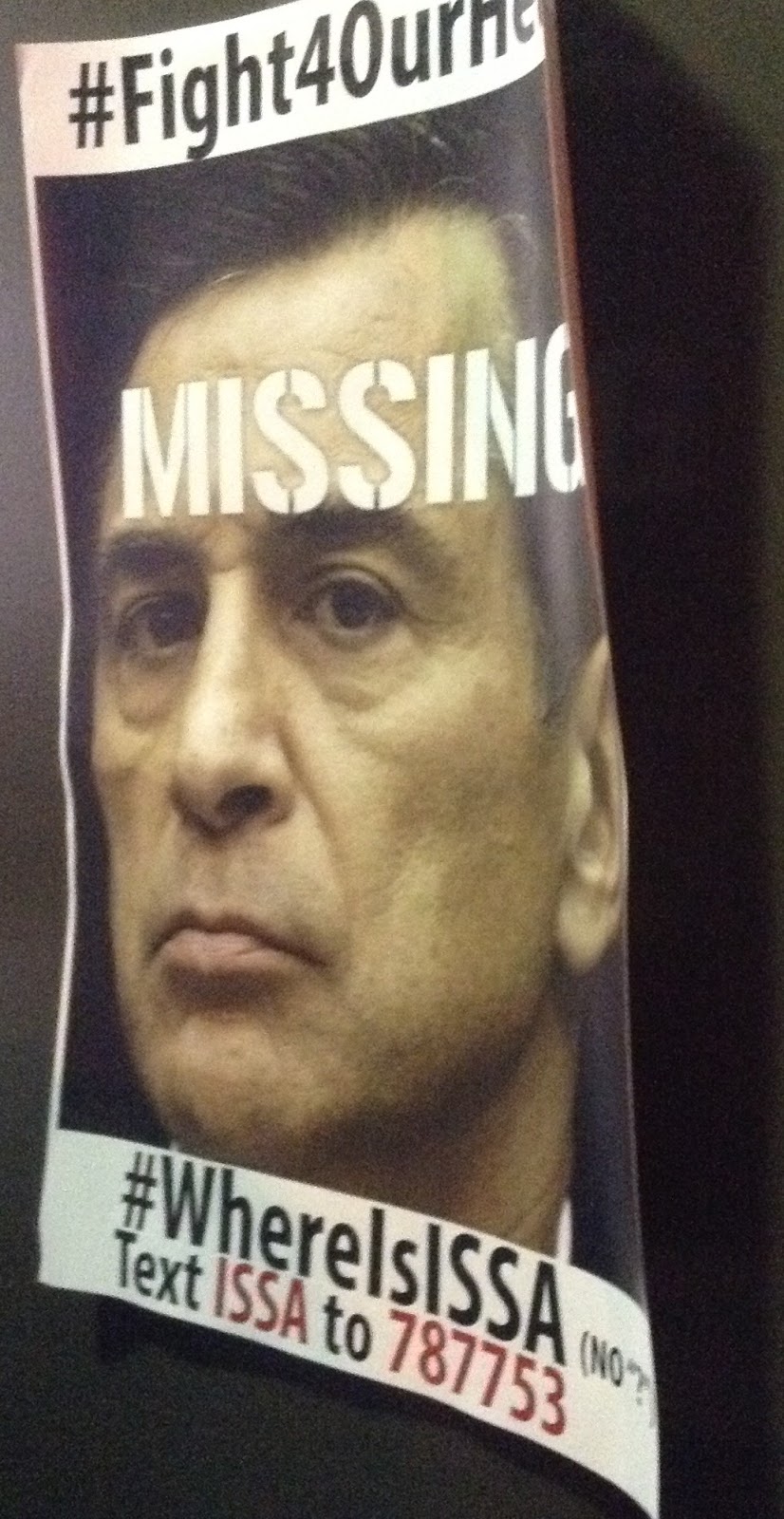
 Vista, by the way, is in North San Diego County, a reliably red part of the state with strong ties to the military.  Darrell Issa, the congressman who represents Vista, is one of the most powerful men in Congress, a nine-term lawmaker who chairs the House Oversight Committee.  A successful entrepreneur worth almost $500 million, he was an early and staunch supporter of Donald Trump during the 2016 election, one in which he defeated his Democratic challenger, ex-Marine Doug Applegate, by a mere 1,600 votes.  Since the election, Issa has born criticized by opponents for failing to appear at town hall-style meetings to which he has been invited.

Still, a progressive rally in Vista?  I was pretty shocked.

So what was going on at this anti-Issa rally?  There were several hundred people in and around the building carrying signs.  My favourite showed the congressman's face on a Waldo cut out:  "Where's Issa?"  I bumped into a friend who had a poster for a candlelight vigil for the "missing" congressman.
But despite the irreverent posters, this was a very sedate affair, I have to say.  The people were overwhelmingly white, middle aged, and mainly concerned about healthcare.  There was no foaming at the mouth.  There was no anti-Trump vitriol.  There were very few self-absorbed whiny millennials, and there were a lot of American flags.  Every so often a halfhearted chant of "Education, not deportation" sprang up, but mostly people were standing around, holding signs, and chatting.  They may as well have been at a tea party.  Inside the Rec Center an "empty chair town hall" meeting was going on.  A female pastor urged those lining up to speak to be respectful and to keep their speeches to a minute in duration.
"Where's Waldo/Issa" cut out at the front of the stage.

 I had Harry Potter and the Deathly Hallows on audio book waiting for me back in the car, so after 15 minutes or so of taking in the atmosphere, I left.  Over the next 20 minutes, the crowd outside dwindled and I could hear snatches of the speeches from the comfort of my minivan.  Still intrigued, I decided that Harry Potter could wait, and I walked back; with the thinning of the crowd, I was able to stand just outside the entrance to the Rec Center and listen to the speeches.  I heard EMTs, military veterans, grandmothers, and other "normal" people speak, many of whom prefaced their remarks with something like "I have never done this before" or "I am not a paid protestor".  The loudest ovation was for a headscarf-wearing Muslim-American woman and her daughter who issued an open invitation to Darrell Issa to come over to her house to drink chai, eat samosas, and talk politics.  Almost every speaker spoke of his or her concerns about healthcare.  No one that I heard disparaged the president.

As I listened, I realised what drew me to this event.  Sure, I probably have a lot more in common politically with this kind of a crowd than with Tea Partiers or pro-Trump supporters, but it felt refreshing to hear normal people talk in normal ways about normal issues.  There were no sensationalist headlines, no fake news (although one speaker did quote something she saw on Facebook...), no antagonistic rhetoric, and no punditry.  Or, to use my students' vernacular, there were no savage burns and no roasts.  

Now, this is not to suggest that political protest should lack energy or righteous anger.  There are times when standing up for truth and civil rights and democracy requires us to be outspoken and noisy.  And certainly, there was nothing that any of these speakers did that threatened to make a difference or change the world.  But in a society where rational discourse is increasingly rare, there is something to be said for people gathering to politely ask their elected representative, who in this case just happens to be one of the most powerful men in the country, what he is going to do about something incredibly important that is under threat.

On that evening, I was getting my news first hand, with no filter.  No one was telling me what they'd heard or seen on a viral video.  When it comes to my community, I now know what people are concerned about.  I know what matters to them.  And for some of these people, the decisions Issa and other Republicans make could literally mean the difference between life and death.

I have no idea if these protests and other gatherings will persist - I drove past another one downtown today - but I resolve to pay much more attention to them than to anything on my Facebook feed, which, by the way, I haven't scrolled through for at least two weeks.

Sunday, November 6, 2016

Introducing Godric. (No, not that one. Or that one either.)


“What’s friendship, when all’s done, but the giving and taking of wounds?"

Godric, a short novel by Frederick Buechner, is one of the most poignant and memorable books I have ever read.  It tells the story of the historical figure, St Godric of Finchdale, a wealthy and successful merchant who became a well-known religious figure and hermit in the 11th and 12th century in north-east England.

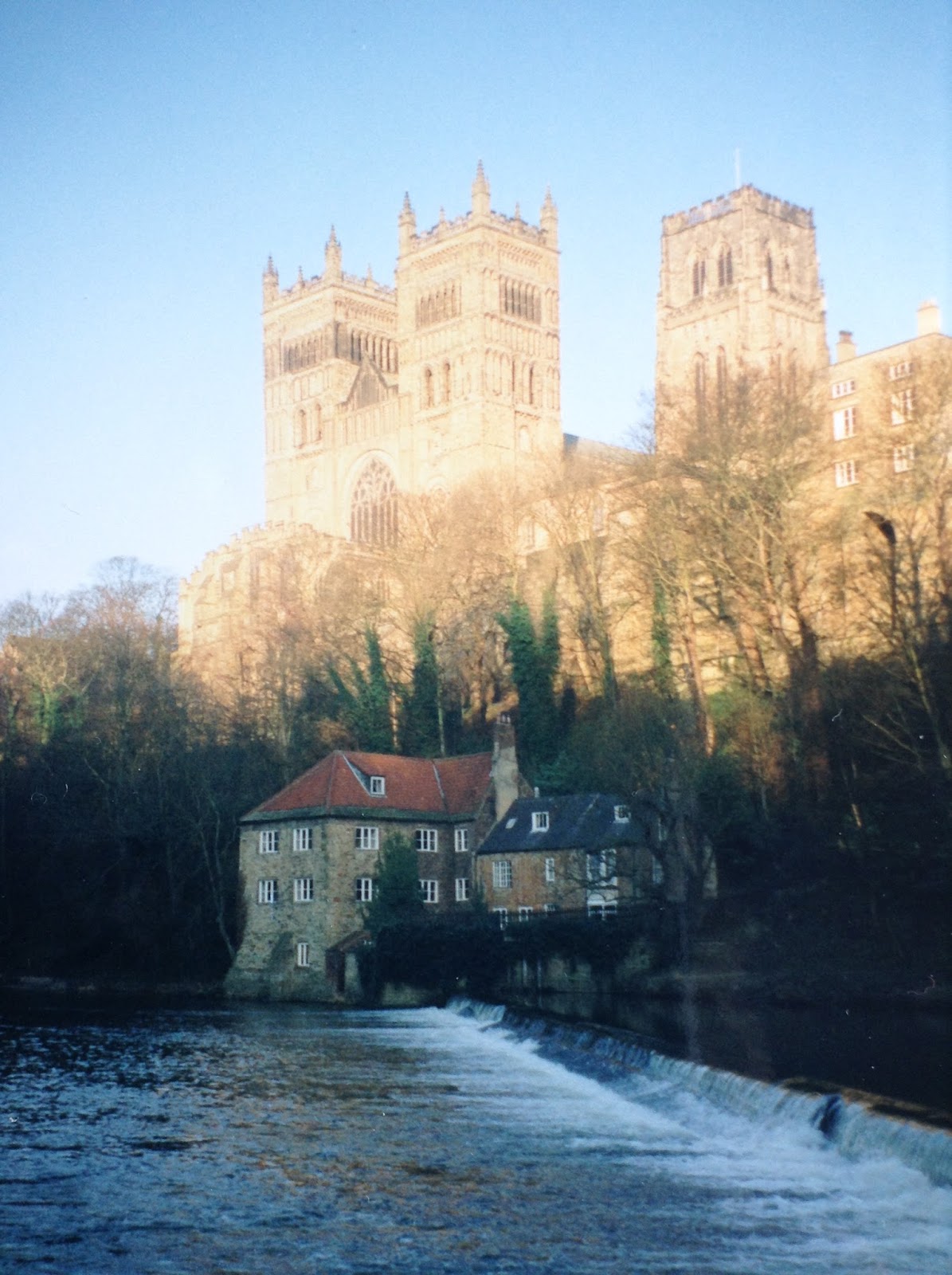
Most of the book is set in and around Durham, a small city that features a magnificent cathedral that dates back to the 11th century.  Located spectacularly on a promontory above a horseshoe-shaped bend in the River Wear (pronounced "weer"), the cathedral - originally set up as a shrine to St Cuthbert - dominates the surroundings.  I spent 5 years in Durham as a student, from 1995 to 2000, and it was where I met my wife, Rachel.
Durham Cathedral, with the River Wear in the foreground, circa 1996.  Taken during my freshman year in college.

Despite the city's renown, Durham County is in a rather bleak and economically depressed part of England.  It features place names such as Chester-le-Street, Esh Winning, and Pity Me.  The winters see bitterly cold winds, sent seemingly straight from Siberia, sweeping across the landscape.  The chafing chill and relentless gray gloom of the winter months prevented me from appreciating the beauty of the place, and Buechner's descriptions of the dreary damp and bone-chilling cold brought back memories of walking down to the library, buffeted by driving wind and desperately trying to keep books and papers dry during a downpour.  Reading dredged up memories of playing hockey in the freezing rain, every hit of the ball a jolt of buzzing vibrations through my numb fingertips.  

Ever-present in Godric is the River Wear.  Personified as an old man, a wild animal, a living, breathing entity, it symbolizes many of the things one would expect of a river: purification, constancy, vitality, an agent of change.  I probably crossed the river's stone arch bridges close to a thousand times over the course of my time in Durham.  Rachel and I took autumn walks along its banks, shuffling through piles of leaves.  In my third year, I lived a Rubeus Hagrid stone's throw from the river and loved standing at its edge, watching its dark waters slide, swirling, silently by.

It is fair to say, then, that Buechner's book resonated with me and even provided me with a nostalgia for Durham I never knew I had.

Strangely, while it is a book that is unashamedly rooted in the Christian faith, it is nonetheless raw and unflinchingly honest in its description of sin.  As I read, I found so many lines and passages that resonated deeply - the kinds of lines that you stop and read out loud to your wife who is trying to sleep - that I started keeping track of them.  Once I finished reading, I typed them up, and it seemed a shame not to find a way to put them into a blog post.

One of the subjects that the novel deals with in a profound, direct, and occasionally shockingly salacious way is lust.  Godric bemoans the fact that, despite his best efforts, lust springs upon him in the most unlikely and inappropriate places.

 “Beware the shadows.  Never think they’re not afoot because the day is fair.  Scratch fair, find foul...for what’s the blood of Christ to him whose own blood seethes like water in a pot?”  

His pleas to God are at times heartbreaking:

“Dear Lord, strew herbs upon my hermit’s dreams to make them sweet.  Have daylight’s mercy on my midnight soul."

Even guarding one's thoughts and intentions against sin, he says, is futile, for: 

“My skull’s a chapel.  So is yours.  The thoughts go in and out like godly folk to mass.  But what of hands that itch for gold?  What of feet that burn to stray down all the soft and leafy paths to Hell, the truant heart that hungers for the love of mortal flesh?  A man can’t live his life within his skull.” 

And even a holy man can get to a point where guilt and self-pity are replaced with a calloused heart, numbness, and cynicism.  I have found no greater or more accurate articulation of the effects of habitual sin than this: 

"In sin’s wake there came a kind of drowsy peace so deep I hadn’t even will enough to loathe myself.”
 
But beautifully, poignantly, Godric remains convinced of his redemption and salvation even through - especially through - tragedy, loss, and his own destructive actions.  The following quote may not relevant to many people, but if you have suffered, lost, grieved, and still seen God's place in it all, then perhaps these achingly beautiful sentences will make sense:

“Praise God for all that’s holy, cold, and dark.  Praise him for all we lose, for all the river of the years bears off.  Praise him for stillness in the wake of pain.  Praise him for emptiness…What’s lost is nothing to what’s found, and all the death that ever was, set next to life, would scarcely fill a cup.”

There is a wonderful juxtaposition between the Godric the religious icon who is revered by the community and Godric the mortal, sinful man who cannot understand why he is revered because he is such a wretched sinner.  Godric reminds us that sin is a constant companion for even those who are venerated by others.  In fact, Buechner may well be pointing out that it is especially in those who are deeply devoted to God that the greatest doubts and frustrations with faith occur.  Most of us, after all, have the most acrimonious arguments with those whom we are closest to.

We often try to see the good in those who are bad, but how often do we recognise, acknowledge, and accept the flaws and inherent sinfulness of those whom we look up to, those under whose authority we place ourselves? 

And if we are to follow that to its logical conclusion, there is an even more difficult challenge: if we know that even the holiest of men struggle with dark thoughts, then maybe we should all feel a lot better about the idea that we should intentionally expose or confess our own sin, even to - especially to - those who think highly of us.

Any takers?  I didn't think so.  

But reading Godric might be a good start.
“I speak a word.  My friend speaks back.  Then I again, then he, and thus we make a bridge of words so each may fetch across the ditch that lies between what’s in his heart.”